Hermès is a rare example of a luxury house whose most coveted creations speak almost in a whisper. It has no need for oversized monograms or a constant pursuit of novelty. You recognize Hermès by leather that ages beautifully, impeccable stitching, the unmistakable orange box, and the quiet confidence of an object that feels just as appropriate today as it will twenty years from now.
The story of Hermès began in Paris in 1837, when Thierry Hermès established a workshop making harnesses for wealthy clients. This is more than a charming piece of brand mythology. Equestrian equipment demanded precision: a saddle or bridle had to be strong, comfortable, perfectly constructed, and worthy of the carriage or horse it accompanied. From this came one of the house’s defining principles: beauty grows out of function, and quality proves itself over time.
That heritage still appears throughout the Hermès vocabulary — equestrian motifs, hardware inspired by harness fittings, saddle stitching, and the famous horse-and-carriage emblem. Even when Hermès creates lipstick, porcelain, or a watch, there is still something of the saddler’s workshop behind the object.
The house’s most famous creations are, of course, the Kelly and Birkin bags.
The Kelly existed long before it acquired its celebrated name. The design became legendary after Grace Kelly was photographed holding the bag in front of her pregnant stomach; Hermès later named the model after the Princess of Monaco.
The Birkin was born from an accidental encounter on an airplane. Jane Birkin told Jean-Louis Dumas that she could not find an elegant yet spacious bag suitable for a young mother. An everyday problem eventually produced an object that would come to feel almost like admission to a private club.
Yet reducing Hermès to these two bags is one of the easiest ways to reveal a relatively recent acquaintance with the house.
Those who know Hermès well may appreciate the Bolide, Constance, Picotin, and Evelyne; Barénia leather; Collier de Chien and Chaîne d’Ancre bracelets; loafers, belts, cashmere blankets, and porcelain.
And then there is the separate universe of the silk carré.
The first Hermès silk scarf appeared in 1937, transforming a square of silk into a small, wearable work of art. A carré can be tied around the neck, wrapped around the handle of a bag, worn in the hair, or used as a belt. Knowing how to wear one with apparent effortlessness is far more convincing than making sure everyone sees the label.
One of the most important Hermès codes is scarcity without commotion.
A Kelly, Birkin, or Constance is not something you simply select online in your preferred color and order for delivery. Availability is discussed in the boutique, and being offered the right bag can depend in part on a client’s relationship with the house.
For that reason, an Hermès bag can communicate more than wealth. It may suggest patience, access, knowledge of the unwritten rules, and a habit of buying objects that belong naturally to a certain way of life rather than pursuing a single trophy.
But loudly recounting the “waiting list,” the price, or the difficulty of obtaining the bag immediately weakens the effect. Real status lies in carrying something rare as though acquiring it had never been a drama in the first place.
Hermès does not believe its creations should become untouchable museum pieces.
Bags are made to be carried. Travel pieces are made to travel. Tableware belongs on the table. A saddle belongs on a horse. The house repairs its creations because patina is not necessarily treated as a flaw; it can become part of an object’s biography.
A brand-new Birkin may impress because of what it costs. An older one — softened with time, visibly used, and clearly loved — can convey something different: belonging.
Among people accustomed to luxury, that distinction matters. The object no longer looks like an attempt to prove status. It appears instead to be a natural part of a life that was established long before anyone was watching.
Part of the enduring power of Hermès also comes from the fact that the house remains family-controlled and independent. It has expanded far beyond its equestrian origins without becoming a factory for instant trends. The hand of the artisan, the selection of materials, and the integrity of construction remain central to its identity.
The signature saddle stitch is made using two ends of the same thread. Even if one stitch is damaged, the entire seam does not simply unravel. It is an almost perfect metaphor for Hermès itself: beauty supported by invisible engineering.
The house also has its own sense of humor.
Its colorful scarves are populated with horses, fantastical creatures, and unexpected narratives, while familiar forms are continually reinterpreted. Hermès is not cold; it simply does not seek approval. Its luxury can be orange, turquoise, or pink, yet even the boldest colors retain a sense of discipline.
For someone just beginning to explore the world of luxury, the best first Hermès purchase does not necessarily have to be a handbag.
A carré, belt, bracelet, fragrance, small leather good, or object for the home can provide an introduction to the language of the house without the exhausting pursuit of a status symbol. What matters more is choosing something that will genuinely become part of your life rather than something that exists mainly to appear in photographs.
Hermès is more than an expensive French luxury house. It is a lesson in how to think about luxury.
It teaches the difference between price and quality, novelty and longevity, recognizability and ostentation, ownership and belonging.
Perhaps the most convincing way to wear Hermès is not to let the object take center stage at all. Let other people notice it for themselves.
Those who know will recognize it anyway.
Best books and practical guides
-
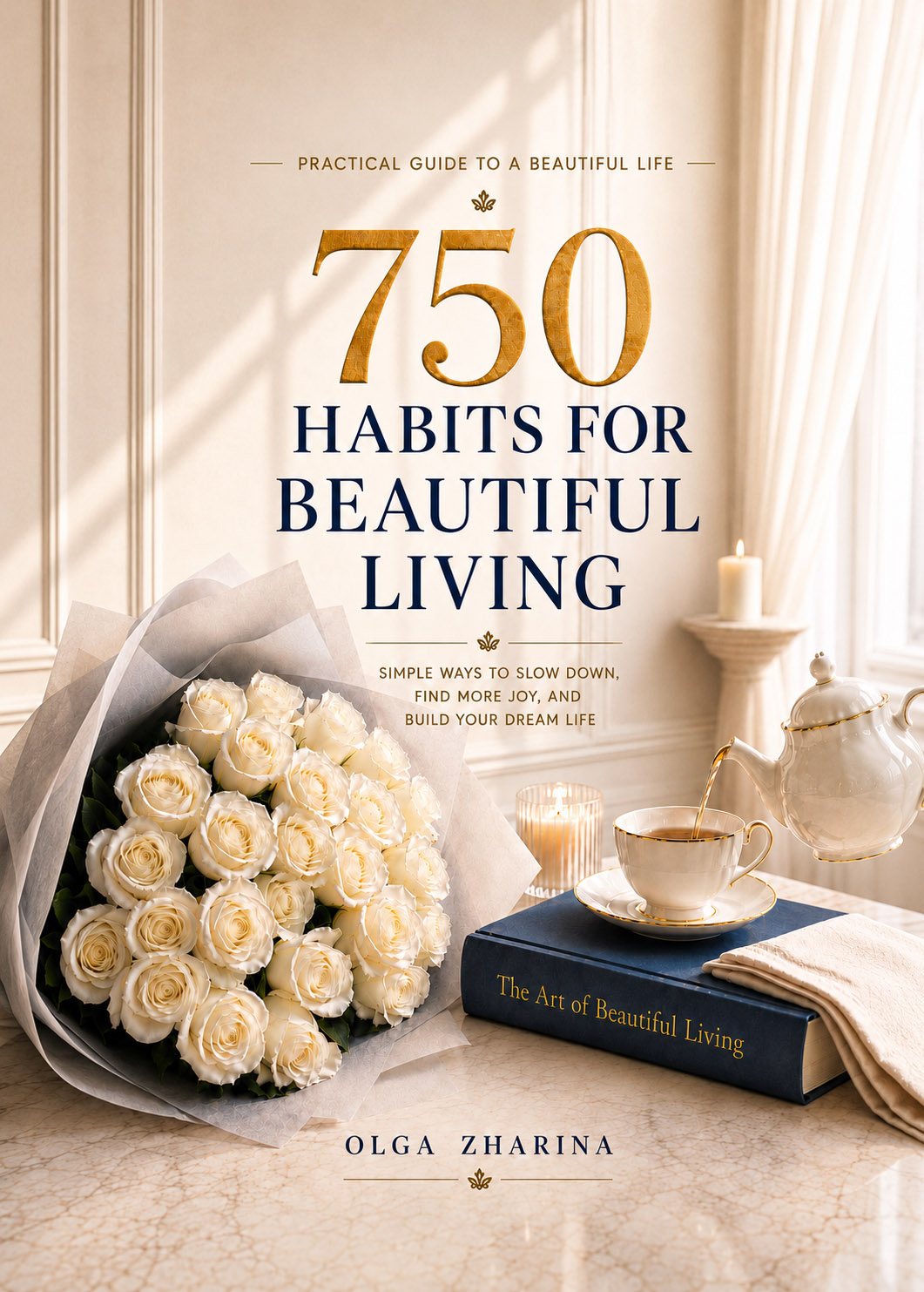
750 Habits for Beautiful Living: Simple Ways to Slow Down, Find More Joy, and Build Your Dream Life
$19.99 -
How to Save Money Guide: Money Tips
Original price was: $16.99.$9.99Current price is: $9.99. -
From Dream to Goal: Financial Goal Setting Guide
Original price was: $16.99.$9.99Current price is: $9.99. -
Luxury Home Decor Guide: Make Your Home Look Expensive on a Budget
Original price was: $16.99.$9.99Current price is: $9.99. -
Small Apartment Interior Design Guide: Make a Small Space Feel Luxurious
Original price was: $16.99.$9.99Current price is: $9.99.